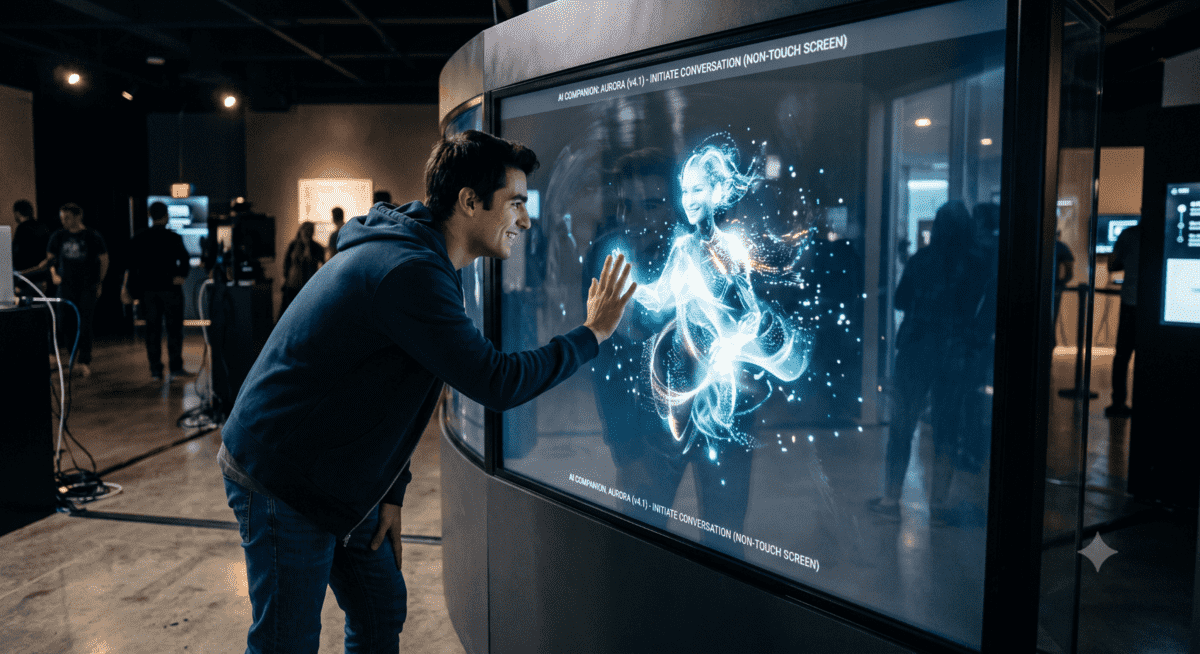
I want to play
We, human beings, want to play. Ask Peter Gray, an expert on “free play” (here or here). Peter Gray puts forward an interesting reasoning: the opposite of playing is not work, it is related to depression.
I will assume that “Peter Gray is right” to move forward. If you are not convinced, his two videos above are more convincing than my paragraphs - if you leave convinced. Therefore, I assume that we humans want to play.
Starting from this assumption, it will be very easy for us to abandon work to AIs and robots. We won't miss it.
I will now start from these two assumptions: we humans want to play; AIs and robots work.
These two assumptions raise several questions. I will first address one: who advertises to whom.
In a world where humans play and AIs work, advertisements will migrate from AI to AI, and I will explain. Let's take it slow, as it is a somewhat new concept.
Roughly speaking, advertising serves to ensure that products and services are sold and bought, in reasonable democracies, chosen and offered - until today - by humans.
When we can focus on playing, we will let AIs take care of “our” companies, including advertising “our” products and services.
In the same way, we will delegate to our personal AIs the task of solving problems, which includes finding the best cost-benefit products and services that fit our budget. Or any prompt you give to your personal AI.
In other words: our AI will decide which product/service we should choose.
So, the AI that offers a product/service will increasingly need to advertise, offer itself, and be seen by other AIs - the AIs that decide what to buy.
In other words, companies will try to sell to consumer AIs. No longer directly to humans.
What is the difference when advertising to an AI? How to be chosen by AIs?
Certainly, there will be differences between advertising to AIs or to humans.
Today I see concerns about AIs “tricking” humans. Yuval Harari coherently exposes the danger of AIs dominating human emotions and, consequently, easily manipulating the actions of the humans they interact with.
I agree with master Yuval (how could I disagree, his reasoning is always very well-grounded, lucid).
I disagree, however, not that AI easily manipulates humans - I do agree with that -, but I propose that AI will start advertising to other AIs and, therefore, humans will end up shielded, unaffected by AI manipulations. At least not regarding what to consume.
From AI to AI, emotion “doesn't work” - obviously.
I will go further: screens (TV, social media) - and AIs are a more powerful screen - cannot trigger many of the emotions that humans trigger in other humans. Here I return to Peter Gray: playing is playing with other humans. Or I remember Richard Cytowic: screens cause fatigue, Cytowic mentions “zoom fatigue”, the fatigue of participating in video conferences (instead of face-to-face meetings). Or I return, again, to Peter Gray: playing is playing without pressure. If there are scores, demands, grades, responsibility, like in college teams, professional football with high salaries at stake and the like, it is no longer playing - it is work!
Look how interesting: the World Cup, that professional football, is work, not play, in Peter Gray's analysis. This is clarifying, almost revolutionary. That's why they look like “robots” playing, you can “feel” the money involved, every match feels more like pain than fun. It's business. (The negation of leisure, incidentally, in the etymology of the word business): millions at stake, bets, sponsors, tickets, who is going to do the halftime show and how much they will earn, how much reputation will increase (etc). Business. Not playing.
Football on the small field next to home, without a trophy, without a score, without demands, that is playing, so much closer, so much easier than the “World Cup”. “Champions League”.
Or hide-and-seek. Laughing. Having tea. Running. Playing.
That's why I think AI and AI make a match, and human and human make a match.
Am I right in this hypothesis, at least in the long run?
Because now, through the dopamine mechanism, machines are running circles around humans. Everyone is glued to a screen backed by an AI: it's an AI that decides the next streaming or post to offer. Video or Image. This screen leaves only a sofa turned towards it. Living rooms with sofas in a circle, prepared for conversations between humans, look as old as carriages once were.
Indeed, citing Cytowic again, screens enter the same dopamine circuitry as opioids and absorb large amounts, if not all, of each person's attention span until they are tired and want to sleep.
My hypothesis is that these human-AI interactions will not last in the long run. I already feel a fatigue of bots, robots, AI. Whenever I talk to someone, interest is higher when I write myself, and much lower when I paste an AI response - even when, and always, the AI response is more complete, and even when I ask it to simulate a human. I feel people want human attention. They want something other than AI “efficiency.” They want the human.
They want to play. Deep down.
Hence the title, the thesis, of this text.
Responses