
🍎 Eugenics in communication?
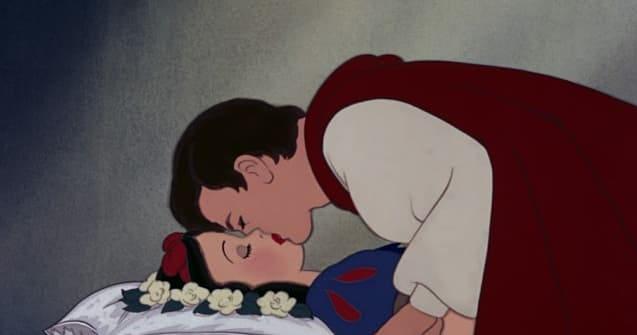
Eight perspectives on the antenna crisis—in which everyone can now speak and publish—, but also in which there are flirts with the restriction of freedom, perhaps stemming from a resentment of those losing a space that until recently was quite select, using justifications as attractive as Snow White's bright red apple.
First perspective: resentment of the aggrieved, who until recently were the few owners of information.
Does the world want more control, or does the world's press want more control? I think the world's press, not the world, wants more control over the population.
Human as we are, we dream of eloquent conspiracy theories, but the real reason is base. Reptilian. We are little animals, but we dream of being far from animals.
Antenas! Behold the reptilian, base reason for the current crisis.
Until a few years ago, 4 or 5 antennas on the highest buildings in the highest regions of each city propagated the great ideas and information of the world to all of us.
Suddenly everyone became an antenna. Uploading with your little cell phone to YouTube. A tweet. A post on Zuckerberg's company trio, face-insta-whats. A Telegram group.
News from the few big antennas slowly began to arrive late compared to cell phone posts.
More and more we learned about things from other humans on their cell phones.
The restricted little world of the few antennas was shrinking. You could no longer have a whiskey with 25% of a country's communication by meeting the owner of a big antenna in a bar near Congress.
You could no longer be close friends with 75% of all communication in a region by having 3 or 4 influential friends with big antennas.
Antenna crisis. Everyone started having, and many using, their antenna on their smartphone..
Hence, very scared people created the looming danger of fake news. As if excessive people meant donkeys, it treats antennas collectively as forbidden, a source of lies that trick idiots.
How can one oppose everyone-with-antennas?
With few antennas.
With a kind of dictatorship of few antennas
With mistrust in the crowd. In the people. As one distrusts donkeys.
Google provided the most beautiful solution before Trump's first election. Pressured by the first wave of fake news, it created, to this day, the most liberating solution I've ever seen:

Instead of restricting, gagging, silencing, censoring, Google multiplied freedom: for each news item posted, its algorithms went after various sources for the same news, or similar news. And it created the button to see more versions of the same news, which it called "full coverage." It expanded information.
But no. That wasn't the goal. The goal wasn't to expand freedom. To expand information. The goal is baser. More reptilian.

the red apple.
Simple: the owners and friends of owners of the few antennas that were once exclusive in the world are thrashing. Convulsing. They don't know where to hide their heads. They don't know how to stop melting advertisers. They don't know how to pay expenses that used to be the highest.
Powerful and with powerful friends, the former few owners of the world, when they thrash, the world feels it.
Waves of authoritarianism appear. Truckers need to represent freedom.
They are thrashing reptiles.
Playboys clinging to their luxury toys: information monopoly.
There's no turning back. We are watching, from the front row, the death of an animal. Influential. Thrashing. Dead.

A column by a journalist flirts with restricting freedom. It creates justifications that are as seductive as possible.
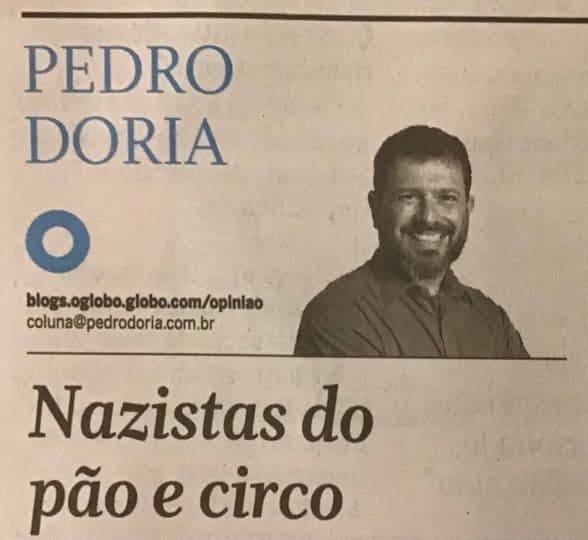
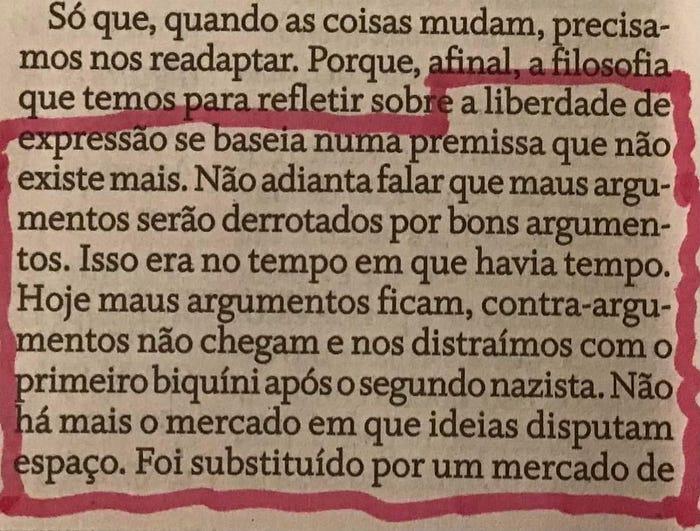
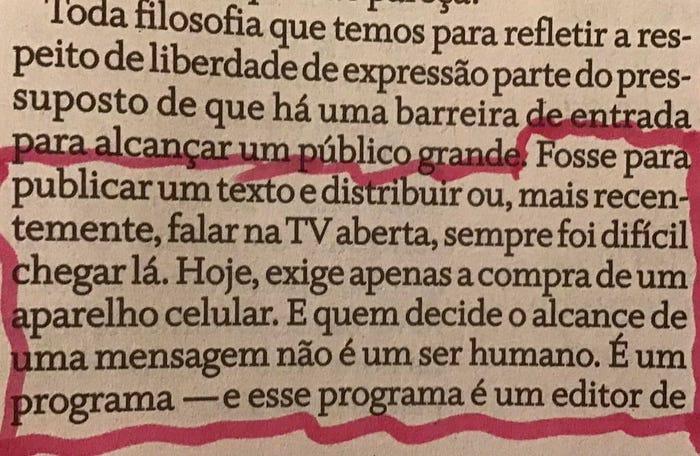
This column by Pedro Doria is a product of the problem I've been reflecting on, which post I linked here, which I've been calling the "antenna crisis." That everyone is now the owner of an antenna: their cell phone.
Second perspective: feeling. What do you feel? An example from traffic.
What did you just feel? Upon hearing "everyone has an antenna." No longer just a few antenna owners?
Because feeling is independent of the phenomenon, the billionization of antennas.
If you feel like putting duct tape over the mouths of billions, or hundreds of millions of people who now have antennas, now we're talking. This is a position with profound political implication.
If you want to let life adjust on its own, the billions of new communicating antennas figuring each other out somehow-who-knows-how, we are also talking. It is a position with profound political implication.
More control? Less control?
Do my personal problems—more control, less control on a personal, psychoanalytical level—influence my decision about everyone else? Or do we know how to separate them?
The traffic example can bring practicality to a subject that is still a bit abstract.
Imagine a city that grows. The number of cars on the streets quadruples. Quintuples. Year after year. Instead of antennas, cars. Everyone now has a car and wants to use it.
In Porto Alegre, I saw this transition with my own eyes.
At first, savagery happens: no one wants to give space to anyone. After about two decades, it reaches the "São Paulo" level, where when you turn on the blinker, the car behind lets you pass instead of accelerating. Here in Porto Alegre we are midway through this path. Savagery has decreased, but it still exists. And in both cities, exceptions will never cease to exist.
In this traffic example, we can observe the two positions, control and lack of control. In both cities, the traffic engineering center (cet) or public transport company (eptc) grew, produced pamphlets, TV campaigns, fines. But people also adjusted without having their cars banned from driving. Everything ends up working out.
What to do?
By the way, there is still another way to observe the phenomenon in which all of us, no longer just a few, possess antennas, can and want to transmit information and opinions.

Snow White and the red apple.
Third perspective: processing power. A flood of synapses.
We are, more or less, capable of 1 quadrillion synapses using our 100 billion neurons. Each of us!
[Damn. Pause because this is incredible.]
We are, therefore, opinion. We are information. We are processing. Capacity. Reasoning.
Let's make an analogy with a cryptocurrency network, like bitcoin. Bitcoin depends on countless computers with enormous processing capacities to verify cryptocurrency transactions. At every instant.
In the same way, we can think of human beings.
Each little human being (ling?) can and wants to contribute their quadrillion synapses to humanity.
For now this is just a way of seeing. Without a solution. A way to ask the right questions.
For example: is there a lack of a structure to house so much reasoning capacity?
It's still too early to know much about this subject, I feel.
Notice that I just gave a practical example: I "moved," I "used" my synaptic capacities to try to increase our knowledge on the subject. I made an effort. "Heated up my head." I contributed, for some psychoanalytically explicable reason (desire for connection, fear of abandonment, or another reason). I donated effort and energy. I donated synaptic capacity. Billions of people also want to donate, and do donate, quadrillions of synapses, every day, on every subject. Billion times quadrillion.
Little by little, we are thinking, literally. Adding up processing. We are processing. We are 7 billion quadrillions of synaptic capacity, as a whole.
Aren't billions of antennas welcome? The stagecoach was replaced by the combustion engine. Can a world with a few giant antennas not be replaced?
Next, I will talk about something that hasn't been said yet either: specialization.

poison in the apple?
Fourth perspective: specialization. The specialist vs. the non-specialist.
It is possible that the journalist of the article above is arguing for specialization.
Few antennas would let only specialists speak, transmit, with great reach.
Let's first understand the positive side of this argument.
What would change in Elon Musk's rocket project if he had to clean the house, every day?
For this, specialization was invented.
A person specialized in cleaning does faster, more efficiently, what the owner of the SpaceX rocket company would take longer to do. And vice versa, the person taking care of cleaning wouldn't be as efficient in the rocket project.
What about communication?
Allowing everyone to communicate is abandoning specialization and, along with it, efficiency?
This is a question, an argument that is not small.
In the locomotion example, not just anyone can pilot Boeings. There is specialization. What about cars? Driving a car no longer requires that much specialization: it only requires a simpler driver's license.
These practical examples don't answer, they only add ways of looking at the problem of everyone being able to communicate, instead of how it was before, when few had this long-range power.
By the way, speaking of reach!
There is a huge difference in the type of reach:
Next comment.
Will we be able to wake up?
Fifth perspective: complex system vs simple communication topology.
The crisis in which everyone can communicate, instead of a few large antennas, presents an important, little-discussed shift:
We have moved from the direct, simpler method to an indirect, more complex method of disclosing and spreading information.
With few antennas, a few spoke for all of us. Direct.
Now, "everyone" speaks. Which news spreads or not happens in a more indirect way.
This allows us to bring up the question of control again.
Our most controlling desires want the death of complex, almost decipherable systems. "We want few antennas back!" our most controlling desires would say.
Our most liberating desires love the creativity and effervescence of complexity.
Life! (Literally).
I just complicated the theme.

There's room for one more comment (damn!).
Sixth perspective: professionalism. Donating communication vs being paid to communicate.
I "donated" 4 comments, above, on this subject. I really tried using my typical human synaptic capacity. Processing capacity. I donated.
However, why did I donate so much effort on a free and public page (facebook, medium)?
Because I'm not a professional is a first answer.
I'm not a professional because I'm not that good in this area is another good hypothesis.
But I'm not entirely bad either. I'm like Elon Musk cleaning his own house. Slower, will mess up some products, forget something, but it will be cleaner.
What about the professional?
The professional charges to contribute. To communicate. To transmit. Earns a salary. Commission.
Behold the fifth and new argument!
In the society we have chosen for now, it is not difficult for advertisers, livelihood, money, to influence when you are at a very professional level.
So professionalism has the real beauty of specialization, of efficiency, but also a bit of subreptitious interests, not out of malice, but to pay the newsroom's electricity bill. To pay for the cold beer.
So the non-professional gains a beauty: they are driven more by the fear of abandonment, by the desire for connection, with less ties to paychecks or finishing the shift soon, they don't even need to fill out a blank sheet when they don't want to, due to a requirement of professional periodicity. But this does not come without a price: the guy is not a professional, as I am not a professional, because he is dumber, less of a specialist, on the subject.
That's why non-professionals, by definition, like me, donate synapses: for free.
Managing billions of quadrillions of less specialized, but not entirely bad, synapses can be a beautiful perspective.
Still just a good perspective to ask the right questions. The solution is still far away!
Who's in a hurry?

The apple is super-attractive.
Therefore, a good perspective to approach the problem could be:
Can we make better use of our limited capacity of 7 billion quadrillion synapses?
Can we decentralize the system?
Can we listen?
I am still just sketching.
I await more donors of quadrillions of synapses! Our strength is in the group.
Yet another perspective on the antenna crisis, in which there are flirts with the restriction of freedom, with justifications as attractive as Snow White's bright red apple.

Seventh perspective: the example of photography, of music.
Today everyone is a photographer, but they are also not a photographer.
Before, few had the investment to have photography equipment. Developing a photo was a chemical process for a few.
Today everyone has a camera, but not everyone is a "for real" photographer.
But there are many more "for real" photographers, very good ones, today than when having equipment and access to a developing lab was difficult.
And even more importantly: who decides who the very good photographers are, among all possible ones?
Ourselves. With photography, at least, it's like that.
What about music?
It no longer requires flattering a giant vinyl printing press to have your music published.
Even so, with everyone being potential musicians, how many of us are "for real" good musicians?
Fewer than all potential musicians, but many more musicians than when it was expensive to press a vinyl record.
Sixth comment of mine!
What beast inside me moves my keys so much?

Does the red apple that justifies flirting with freedom move me? You?
Eighth perspective: eugenics in communication?
Pedro Doria, in his article "Nazis of Bread and Circus," may be acting like a Nazi, at the same time he abhors being a Nazi.
In this excerpt from the article, he abhors being a Nazi:
“here, as in any corner of the West, the second golden rule is not crossed. Holocaust and pedophilia are themes that are not messed with”.
Already in this excerpt here, let's observe:
“Only those who developed one or more capabilities managed to speak to many people. They studied hard or sophisticated their political skills (…)”
Few people know—the case is a historical disgrace—that long before Hitler came to power in Germany, Carrie Buck was sterilized, by decision of the American Supreme Court, for being feebleminded (Buck v. Bell, 1927). Hitler hadn't even come to power yet.
Pedro Doria, without realizing it, is accusing those who do NOT "develop one or more capabilities," who do NOT "study hard," or who do NOT "sophisticate their political skills" of being stupid or idiots. He also says that these, if it were according to the old rules, wouldn't be allowed to speak.
Before being sterilized by decision of the American Supreme Court, Carrie Buck, under the accusation of "idiot," was interned in the concentration camp, called a "colony," of "Lynchburg Colony," in Virginia, in 1924.
Then 9 years later Hitler becomes German chancellor. He does what we know he did. And everyone sweeps under the rug what they did outside of Germany, before Hitler came to power.
Will this argument by Pedro Doria, in the future, go under the rug, pretending it never existed—to err is human and understandable—, or does it actually have substance?

Responses