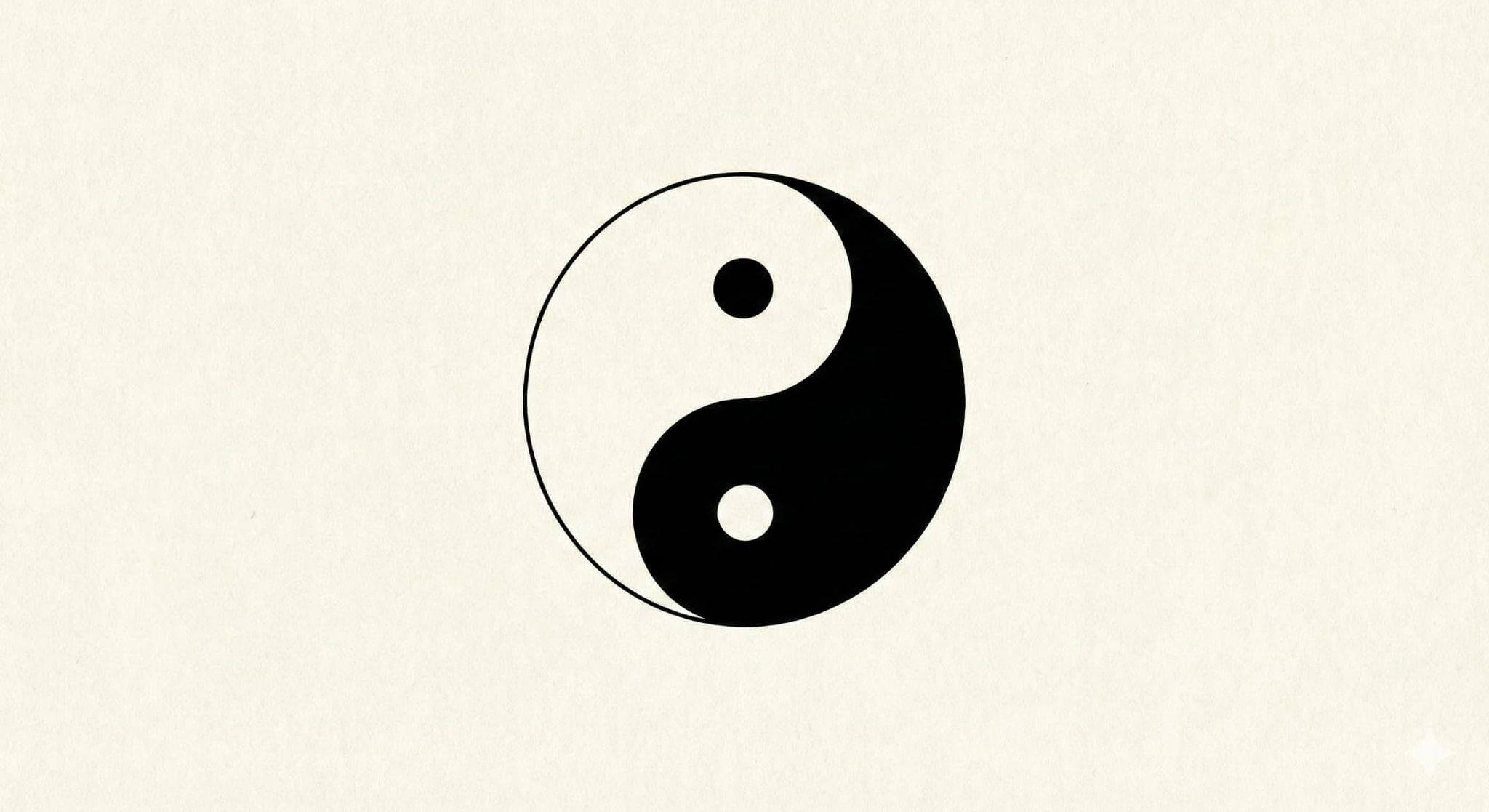
Yin Yang
Kerstin Uvnäs Moberg (The Oxytocin Factor) compares our two great systems to the philosophy of Yin Yang:
The stressed mode.
The peace and love mode.
Our stressed mode - fight or flight - has fewer and fewer lions to quickly alert us, as lions are increasingly caged.
But a new lion never deactivates our stressed mode, I'll venture to say: the lion of compulsive consumption.
I start the argument by saying that “vinegar doesn't make a profit,” meaning that products without high added value, easy to produce, are sold at almost their cost price, yielding little to no profit for any entrepreneur, usually several, who decide to produce it. It's a simplified paragraph, but an important part of the argument.
What makes a profit? Brand. Value. Paying much more than the actual cost of the product. Paying much more than the actual cost of the product is, literally, profit for the producer. In contrast to vinegar, let's call this product “organic ecological canned water.”
Imagine spending a childhood walking past ads for ecological water at 40 reais a can, original surfer X t-shirts at 450 reais each - and so on.
Imagine that vinegar and tap water, and t-shirts for 7 reais are not advertised anywhere. They are just available, if you look for them.
A layer of “stress” needs to be created to push people - from childhood, even better - to desire the advertised products.
On the other hand, it takes a lot of tranquility, a lot of peace and love, not to feel cornered by almost inescapable ads, everywhere. On big screens, on small screens, in soap operas and movies, on billboards, in merchandising, in the mouths of already hooked people commenting.
We have both modes: the stressed mode and the peace and love mode.
We can plant the stressed mode from the womb, with competitive trilingual daycares and parents concerned with maintaining the competitiveness of the next generation, without ever stopping.
But what if a single child - and perhaps their parents and neighbors - is born in peace and love mode?
The peace and love mode is contagious - just as contagious as the stressed mode.
It is possible to hijack the peace and love mode by taking away essential things for life, such as a place to live.
This phenomenon particularly happens in immense cities, such as New York. London, Tokyo. São Paulo.
In these cities, the stressed mode has taken over so many people, in such little space, that it's no longer possible to get a space in the city without being, in stressed mode, trying to produce things with high added value. Real estate is very expensive. Everyone is “half-rich.” There is no room for little work.
Another way to hijack the peace and love mode is to hijack the most beautiful people.
If the most beautiful people seek out the wealthiest people, for some reason - for example, because real estate is expensive, which brings us back to the problem of immense cities - then people more focused on the peace and love mode will have to settle for less beautiful people and less valuable properties.
Another way to sell “wind” is to sell fame.
If people in peace and love mode allow themselves to be influenced by screens displaying rare individuals, such as very beautiful people and, frequently, people attractive by the very fact of being on hard-to-reach screens, thus famous, then these people too will have to enter stressed mode to be able to “get on screens,” that is, to be part of the select group filmed by rare screens.
The peace and love mode is governed by oxytocin.
The stressed mode is governed by cortisol.
The peace and love mode is dangerous for large stressed cities, why?
Because it is extremely self-sufficient. In peace and love mode, everything is fine or almost fine. Including the seven-reais t-shirt, the two-reais vinegar, and tap water. We are all friends.
Only the stressed mode competes with others to see who has the most valuable t-shirt. Or the most “glamorous” water.
Only the stressed mode works stressed its entire life, fleeing the stress of bills, fleeing the stress of being just another one (with a seven-reais t-shirt and two-reais vinegar). Trying to get “there” - far from the ground, from vinegar, from tap water.
The ground “is lava” in stressed mode. The ground is pleasant in peace and love mode.
We have both modes. We use both modes. Like the philosophy of yin and yang.
We can, however, have the peace and love mode hijacked by the stressed mode, through the hijacking of our ground - literally real estate, in large cities, plus the need - artificially created? - for all of us to live in these immense cities.
They hijack our most beautiful people who sell themselves for ground, for expensive products, in exchange for their rare beauty. Leaving people who would only be in peace and love mode without the greatest beauties, who are hijacked by the stressed mode of life - on top of skyscrapers, with rare screens filming them.
Like in zombie movies, the stressed mode infects everyone it can. Whoever is not on top of skyscrapers dreams of being on one and buys this dream, thus also bitten by the stressed mode.
The stressed mode is gaining an air of normality, with its agitation, worry, almost incessant work.
The peace and love mode takes on the air of a disease. Peculiarity. Strange. Conformism?
The nonconformity of the stressed mode becomes normal.
The era of abundance that may be arriving when billions of robots and artificial intelligences work well could be a cold shower for the stressed mode.
Let's call the stressed mode yang and the peace and love mode yin.
It may be that we transform the predominance of yang into the predominance of yin.
It may be that the peace and love mode quickly replaces the predominance of the stressed mode.
If we really have these two modes - which biology indicates to us - it would be interesting to see humanity flourish with a predominance of the peace and love mode, just to compare with our current predominance, which is the predominance of the stressed mode.
Responses